

How To Convert 1:15 Scale Drawing To Inches
Calibration a measurement to a larger or smaller measurement, which is useful for compages, modeling, and other projects. You can likewise add together the existent size and scaled size to notice the calibration factor.
Detect the Scaled Size
Find the Scale Factor
Scaled Results:
Acquire how we calculated this below
On this folio:
- Scale Conversion Calculator
- How to Scale Upwards or Down
- How to Notice the Scale Factor
- How to Reduce the Scale Factor
- Unremarkably Used Architectural Scales
- Ordinarily Used Model Scales
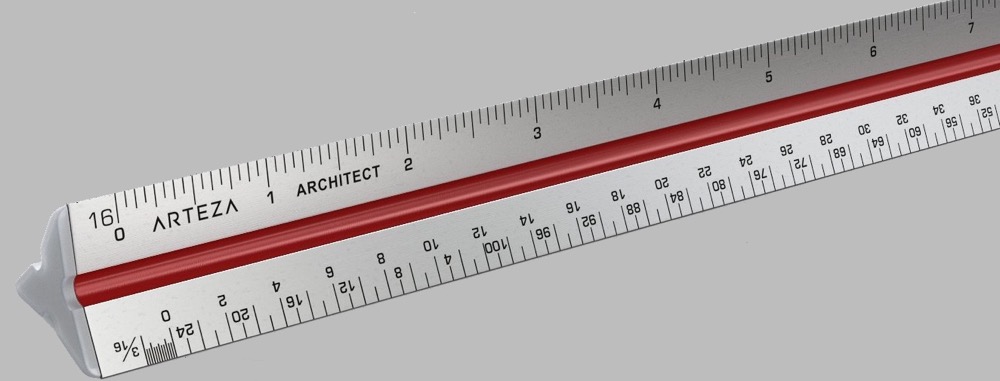
How to Calibration Upwardly or Down
Making a measurement smaller or larger, known as calibration conversion, requires a mutual calibration gene, which yous can use to multiply or divide all measurements past.
To scale a measurement down to a smaller measurement, for example, when making a design, only divide the existent measurement by the scale cistron. The calibration factor is ordinarily expressed as i:north or i/n, where n is the factor.
For example, if the scale factor is ane:viii and the real measurement is 32, divide 32 ÷ 8 = four to convert.
To convert a scaled measurement up to the actual measurement, just multiply the smaller measurement by the scale factor. For example, if the scale factor is 1:8 and the smaller length is 4, multiply iv × 8 = 32 to catechumen it to the larger bodily size.
How to Find the Calibration Factor
A calibration factor is a ratio of 2 corresponding measurements or lengths. You can utilize the factor to increment or decrease the dimensions of a geometric shape, drawing, or model to unlike sizes. You lot can discover the scale factor in a few easy steps.
Step One: Utilize the Scale Factor Formula
Since the scale cistron is a ratio, the first step to finding information technology is to utilize the following formula:
calibration gene = scaled size existent size
So, the scale cistron is a ratio of the scaled size to the real size.
Step Two: Simplify the Fraction
The next stride is to reduce or simplify the fraction.
If you're scaling down, so the ratio should be shown with a numerator of 1. If you're scaling upwards, then the ratio should be shown with a denominator of ane.
To find the concluding scale factor when you lot're scaling up, reduce the ratio to a fraction with a denominator 1. To do this, divide both the numerator and the denominator by the denominator.
If you lot're scaling downward, and then reduce the fraction then that the numerator is one. You tin can do this by dividing both the numerator and the denominator by the numerator.
Our fraction simplifier can assistance with this step too, if needed.
Step Three: Rewrite the Fraction as a Ratio
Finally, rewrite the fraction as a ratio by replacing the fraction bar with a colon. For instance, a scale factor of 1/ten tin can be rewritten as 1:10.
For case, let's find the calibration cistron used on an architectural drawing where ½" on the cartoon represents 12″ on the final building.
Replace the values in the formula higher up.
scale cistron = ½" 12″
Since the drawing is scaled downwardly, then the scale factor should be reduced to a fraction with a denominator of 1.
Multiply both the numerator and denominator by 2 to simplify.
scale cistron = ½" × 2 12″ × ii = 1 24
And finally, rewrite the fraction as a ratio.
scale cistron = i 24 = 1:24
Thus the calibration cistron for this cartoon is 1:24.
How to Reduce the Calibration Factor
If you already know the calibration gene, but information technology is non in the form of 1:due north or 1/n, then some boosted work is needed to reduce or simplify information technology. If the ratio is 2:3, for example, and so you'll demand to reduce it to and then that the numerator is i.
Use our ratio reckoner to reduce a ratio. Y'all can also reduce a ratio past dividing both the numerator and the denominator past the numerator.
For example: reduce 2/3 by dividing both numbers by 2, which would be one/1.5 or ane:i.5.
2 ÷ 2 = ane
3 ÷ ii = 1.5
scale factor = ane:1.v
Normally Used Architectural Scales
| Architectural Scale | Scale Factor |
|---|---|
| 1/16″ = 1′ | ane:192 |
| 3/32″ = 1′ | 1:128 |
| 1/viii″ = one′ | 1:96 |
| 3/16″ = 1′ | 1:64 |
| 1/4″ = ane′ | 1:48 |
| three/8″ = i′ | 1:32 |
| 1/two″ = 1′ | ane:24 |
| 3/4″ = 1′ | 1:16 |
| ane″ = 1′ | 1:12 |
| i i/2″ = i′ | ane:viii |
| iii″ = ane′ | i:4 |
Unremarkably Used Model Scales
| Scale Gene | Model Type |
|---|---|
| i:4 | steam trains, RC planes |
| ane:8 | steam trains, cars |
| 1:10 | figures |
| one:12 | cars, motorcycles, dollhouses |
| i:16 | steam trains, cars, motorcycles, military vehicles, figures |
| 1:18 | diecast cars |
| 1:twenty | formula one cars |
| 1:22.5 | Yard-estimate trains |
| 1:24 | cars, trucks, aircraft, dollhouses |
| 1:25 | cars, trucks |
| 1:32 | 1 gauge trains, cars, aircraft, figures |
| 1:35 | military vehicles |
| 1:43 | O-approximate trains, cars, trucks |
| 1:48 | O-gauge trains, dollhouses, Lego minifig |
| ane:64 | S-gauge trains, diecast cars, Hotwheels:Matchbox |
| 1:72 | aircraft, armed forces vehicles, boats, cars |
| 1:76 | aircraft, armed services vehicles |
| 1:87 | HO-guess trains, military vehicles |
| 1:96 | ships, spacecraft |
| one:100 | aircraft, spacecraft |
| ane:120 | TT-approximate trains |
| 1:144 | ships, rockets, spacecraft |
| 1:160 | N-gauge trains, wargaming |
| one:200 | shipping, ships |
| 1:220 | Z-gauge trains |
| i:285 | wargaming |
| i:350 | ships |
| one:700 | ships |
| ane:720 | ships |

Source: https://www.inchcalculator.com/scale-calculator/
Posted by: blakeronfiess.blogspot.com
0 Response to "How To Convert 1:15 Scale Drawing To Inches"
Post a Comment