

Who Invited Makeup Who Was The Worlds First Kmakeup Artist
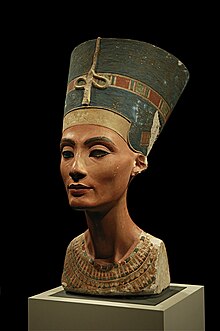
The history of cosmetics spans at least seven,000 years and is present in most every society on earth. Cosmetic body fine art is argued to have been the earliest grade of a ritual in homo culture. The evidence for this comes in the class of utilised red mineral pigments (red ochre) including crayons associated with the emergence of Homo sapiens in Africa.[1] [two] [3] [4] [5] [vi] Cosmetics are mentioned in the Old Testament—two Kings 9:30 where Jezebel painted her eyelids—approximately 840 BC—and the book of Esther describes various beauty treatments too.
Cosmetics were also used in ancient Rome, although much of Roman literature suggests that information technology was frowned upon. Information technology is known that some women in ancient Rome invented brand up including lead-based formulas, to whiten the skin, and kohl to line the optics.[7]
Across the globe [edit]
North Africa [edit]
Egypt [edit]
One of the earliest cultures to use cosmetics was ancient Egypt, where both Egyptian men and women used makeup to enhance their advent. The use of cosmetics in Aboriginal Egypt is well documented. Kohl has its roots in north Africa. The utilise of blackness kohl eyeliner and eyeshadows in dark colours such equally blue, red, and black was common, and was normally recorded and represented in Egyptian art, as well every bit being seen in Egyptian hieroglyphs. Ancient Egyptians also extracted red dye from fucus-algin, 0.01% iodine, and some bromine mannite,[ vague ] simply this dye resulted in serious illness. Lipsticks with shimmering effects were initially made using a pearlescent substance institute in fish scales, which are still used extensively today.[8] Despite the hazardous nature of some Egyptian cosmetics, ancient Egyptian makeup was also thought to have antibacterial properties that helped prevent infections.[ix] Remedies to care for wrinkles independent ingredients such as gum of frankincense and fresh moringa. For scars and burns, a special ointment was made of carmine ochre, kohl, and sycamore juice. An alternative handling was a poultice of carob grounds and love, or an ointment fabricated of knotgrass and powdered root of wormwood. To improve breath the ancient Africans chewed herbs or frankincense which is notwithstanding in use today. Jars of what could be compared with setting balm have been found to comprise a mixture of beeswax and resin. These doubled as remedies for bug such as baldness and greying hair. They also used these products on their mummies, because they believed that it would brand them irresistible in the after life.
Middle East [edit]
Cosmetics are mentioned in the Former Testament, such as in 2 Kings ix:thirty, where the biblical figure Jezebel painted her eyelids (approximately 840 BC). Cosmetics are as well mentioned in the book of Esther, where beauty treatments are described.
Asia [edit]
China [edit]
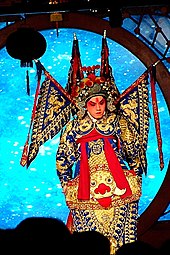
Flowers play an important decorative role in Red china. Legend has it that once on the seventh day of the 1st lunar month, while Princess Shouyang, daughter of Emperor Wu of Liu Song, was resting nether the eaves of Hanzhang Palace near the plum copse after wandering in the gardens, a plum blossom drifted down onto her fair face, leaving a floral imprint on her brow that enhanced her beauty further.[10] [11] [12] The courtroom ladies were said to be so impressed, that they started decorating their own foreheads with a small fragile plum flower design.[10] [11] [xiii] This is also the mythical origin of the floral manner, meihua zhuang [11] (梅花妝; literally "plum blossom makeup"), that originated in the Southern Dynasties (420–589) and became popular amongst ladies in the Tang (618–907) and Song (960–1279) dynasties.[thirteen] [14]
Mongolia [edit]
Women of majestic families painted cerise spots on the middle of their cheeks, right nether their eyes. Nonetheless, it is a mystery why. They said that red cheeks are a reason of happy queen.[ citation needed ]
Nippon [edit]

A maiko in the Gion district of Kyoto, Japan, in full make-up. The style of the lipstick indicates that she is still new.
In Nippon, geisha wore lipstick made of crushed safflower petals to paint the eyebrows and edges of the eyes likewise equally the lips, and sticks of bintsuke wax, a softer version of the sumo wrestlers' hair wax, were used by geisha every bit a makeup base. Rice powder colors the face and dorsum; rouge contours the eye socket and defines the nose.[15] [ unreliable source? ] Ohaguro (blackness paint) colours the teeth for the ceremony, chosen Erikae, when maiko (apprentice geisha) graduate and go independent. The geisha would also sometimes employ bird droppings to compile a lighter color.
Western Asia [edit]

Cosmetics were used in Persia and what today is Islamic republic of iran from ancient periods.[ citation needed ] Kohl is a blackness powder that is used widely across the Western farsi Empire. Information technology is used as a powder or smeared to darken the edges of the eyelids like to eyeliner.[16] Later on Farsi tribes converted to Islam and conquered those areas, in some areas cosmetics were just restricted if they were to disguise the real look in order to mislead or crusade uncontrolled desire.[ commendation needed ] In Islamic law, despite these requirements, there is no accented prohibition on wearing cosmetics; the cosmetics must non be made of substances that harm one's body.
An early on teacher in the 10th century was Abu al-Qasim al-Zahrawi, or Abulcasis, who wrote the 24-volume medical encyclopedia Al-Tasrif. A chapter of the 19th volume was dedicated to cosmetics. As the treatise was translated into Latin, the cosmetic chapter was used in the West. Al-Zahrawi considered cosmetics a co-operative of medicine, which he called "Medicine of Beauty" (Adwiyat al-Zinah). He deals with perfumes, scented aromatics and incense. There were perfumed sticks rolled and pressed in special molds, peradventure the earliest antecedents of nowadays-day lipsticks and solid deodorants. He also used oily substances called Adhan for medication and adornment.[ citation needed ]
Europe [edit]

Cultures to use cosmetics include the ancient Greeks [5] [6] and the Romans. In the Roman Empire, the use of cosmetics was common among prostitutes and rich women. Such adornment was sometimes lamented by certain Roman writers, who thought information technology to exist against the castitas required of women past what they considered traditional Roman values; and later by Christian writers who expressed similar sentiments in a slightly different context. Pliny the Elder mentioned cosmetics in his Naturalis Historia, and Ovid wrote a book on the topic.
Pale faces were a trend during the European Centre Ages. In the 16th century, women would bleed themselves to accomplish pale peel. Spanish prostitutes wore pink makeup to contrast pale skin.[ citation needed ] 13th century Italian women wore crimson lipstick to testify that they were upper form.[17] Use of cosmetics continued in Centre Ages, where the face was whitened and the cheeks rouged;[18] during the later 16th century in the W, the personal attributes of the women who used makeup created a need for the product among the upper form.[ vague ] [eighteen] Cosmetics continued to be used in the following centuries, though attitudes towards cosmetics varied throughout time, with the apply of cosmetics being openly frowned upon at many points in Western history. In the 19th century, Queen Victoria publicly declared makeup improper, vulgar, and acceptable only for use past actors,[nineteen] with many famous actresses of the time, such as Sarah Bernhardt and Lillie Langtry using makeup.
19th-century manner ideals of women appearing delicate, feminine and pale were achieved by some through the use of makeup, with some women discreetly using rouge on their cheeks and drops of belladonna to dilate their eyes to announced larger. Though cosmetics were used discreetly by many women, makeup in Western cultures during this time was generally frowned upon, particularly during the 1870s, when Western social etiquette increased in rigidity. Teachers and clergy were specifically forbidden from the use of cosmetic products.
Americas and Australia [edit]
Some Native American tribes painted their faces for formalism events or battle.[ commendation needed ] Similar practices were followed past Aboriginals in Australia.
The examples and perspective in this commodity deal primarily with the U.s. and do not represent a worldwide view of the subject field. Y'all may better this commodity, hash out the issue on the talk page, or create a new article, as appropriate. (November 2017) (Learn how and when to remove this template message)
19th century [edit]
During the late 1800s, the Western cosmetics manufacture began to grow due to a ascent in "visual cocky-awareness," a shift in the perception of color cosmetics, and improvements in the safety of products.[20] Prior to the 19th century, limitations in lighting engineering science and access to reflective devices stifled people'due south ability to regularly perceive their advent. This, in turn, express the need for a corrective market and resulted in individuals creating and applying their ain products at abode. Several technological advancements in the latter half of the century, including the innovation of mirrors, commercial photography, marketing and electricity in the home and in public, increased consciousness of one's appearance and created a demand for cosmetic products that improved one's paradigm.[20]
Face powders, rouges, lipstick and similar products made from home were found to have toxic ingredients, which deterred customers from their apply. Discoveries of non-toxic cosmetic ingredients, such every bit Henry Tetlow's 1866 use of zinc oxide as a face pulverization, and the distribution of cosmetic products by established companies such as Rimmel, Guerlain, and Hudnut helped popularize cosmetics to the broader public.[20] Skincare, along with "confront painting" products like powders, also became in-need products of the cosmetics manufacture. The mass advertisements of cold cream brands such as Swimming's through billboards, magazines, and newspapers created a loftier need for the product. These advertisement and cosmetic marketing styles were soon replicated in European countries, which further increased the popularity of the advertised products in Europe.[twenty]
20th century [edit]

Audience applying makeup at lecture by beautician in Los Angeles, c. 1950.
During the early 1900s, makeup was not excessively popular. In fact, women hardly wore makeup at all. Make-up at this time was still more often than not the territory of prostitutes, those in cabarets and on the black & white screen.[21] Face up enameling (applying bodily paint to the face) became popular amid the rich at this time in an endeavor to look paler. This practice was dangerous due to the principal ingredient oftentimes being arsenic.[22] Pale skin was associated with wealth because it meant that one was not out working in the sun and could beget to stay inside all day. Cosmetics were so unpopular that they could not be bought in department stores; they could only be bought at theatrical costume stores. A adult female's "makeup routine" often just consisted of using papier poudré, a powdered newspaper/oil blotting canvass, to whiten the nose in the winter and smoothen their cheeks in the summer. Rouge was considered provocative, so was but seen on "women of the night." Some women used burnt matchsticks to darken eyelashes, and geranium and poppy petals to stain the lips.[22] Vaseline became high in demand because it was used on chapped lips, as a base of operations for hair tonic, and soap.[22] Toilet waters were introduced in the early 1900s, but simply lavender h2o or refined cologne was open-door for women to wear.[23] Cosmetic deodorant was invented in 1888, by an unknown inventor from Philadelphia and was trademarked under the proper name "Mum". Roll-on deodorant was launched in 1952, and aerosol deodorant in 1965.
Effectually 1910, brand-upwards became fashionable in the United states of America and Europe owing to the influence of ballet and theatre stars such as Mathilde Kschessinska and Sarah Bernhardt. Colored makeup was introduced in Paris upon the arrival of the Russian Ballet in 1910, where ochers and crimsons were the nigh typical shades.[24] The Daily Mirror dazzler book showed that cosmetics were at present acceptable for the literate classes to wear. With that said, men often saw rouge as a mark of sexual activity and sin, and rouging was considered an admission of ugliness. In 1915, a Kansas legislature proposed to brand it a misdemeanor for women under the age of forty-four to wear cosmetics "for the purpose of creating a fake impression."[25] The Daily Mirror was one of the starting time to propose using a pencil line (eyeliner) to elongate the middle and an eyelash curler to accentuate the lashes. Eyebrow darkener was as well presented in this beauty volume, created from gum Arabic, Indian ink, and rosewater.[26] George Burchett developed cosmetic tattooing during this time catamenia. He was able to tattoo on pink blushes, red lips, and night eyebrows. He too was able to tattoo men disfigured in the First Globe War by inserting pare tones in damaged faces and by covering scars with colors more pleasing to the eye.[27] Max Cistron opened up a professional makeup studio for stage and screen actors in Los Angeles in 1909.[28] Fifty-fifty though his shop was intended for actors, ordinary women came in to purchase theatrical center shadow and eyebrow pencils for their home use.
In the 1920s, the pic manufacture in Hollywood had the about influential bear on on cosmetics. Stars such as Theda Bara had a substantial effect on the makeup industry. Helena Rubinstein was Bara'south makeup artist; she created mascara for the actress, relying on her experiments with kohl.[29] Others who saw the opportunity for the mass-market of cosmetics during this time were Max Factor, Sr., and Elizabeth Arden. Many of the present 24-hour interval makeup manufacturers were established during the 1920s and 1930s. Lipsticks were ane of the near popular cosmetics of this fourth dimension, more then than rouge and powder, considering they were colorful and inexpensive. In 1915, Maurice Levy invented the metal container for lipstick, which gave license to its mass production.[thirty] The Flapper style besides influenced the cosmetics of the 1920s, which embraced dark eyes, red lipstick, red smash polish, and the suntan, invented as a way statement by Coco Chanel. The eyebrow pencil became vastly popular in the 1920s, in office because it was technologically superior to what it had been, due to a new ingredient: hydrogenated cottonseed oil (also the central constituent of some other wonder product of that era Crisco Oil).[31] The early commercial mascaras, like Maybelline, were simply pressed cakes containing lather and pigments. A woman would dip a tiny brush into hot water, rub the bristles on the block, remove the excess past rolling the brush onto some blotting paper or a sponge, and then employ the mascara every bit if her eyelashes were a watercolor sail.[31] Eugène Schueller, founder of L'Oréal, invented mod synthetic pilus dye in 1907 and he also invented sunscreen in 1936.[32] The kickoff patent for a nail smooth was granted in 1919. Its colour was a very faint pink. Information technology'south not clear how dark this rose was, but any daughter whose nails were tipped in any pinkish darker than a baby's blush risked gossip well-nigh being "fast."[31] Previously, only agricultural workers had sported suntans, while fashionable women kept their skins as pale as possible. In the wake of Chanel's adoption of the suntan, dozens of new fake tan products were produced to help both men and women achieve the "sun-kissed" expect. In Asia, peel whitening continued to represent the ideal of dazzler, as it does to this day.
In the time period after the First World War, there was a boom in corrective surgery. During the 1920s and 1930s, facial configuration and social identity dominated a plastic surgeon's earth. Face up-lifts were performed as early on as 1920, just information technology wasn't until the 1960s when cosmetic surgery was used to reduce the signs of crumbling.[33] During the twentieth century, corrective surgery mainly revolved around women. Men simply participated in the practise if they had been disfigured by the war. Silicone implants were introduced in 1962. In the 1980s, the American Society of Plastic Surgeons made efforts to increment public awareness about plastic surgery. As a result, in 1982, the Usa Supreme Court granted physicians the legal right to annunciate their procedures.[34] The optimistic and simplified nature of narrative advertisements often made the surgeries seem take chances-free, even though they were anything but. The American Society for Aesthetic Plastic Surgery reported that more than than two 1000000 Americans elected to undergo cosmetic procedures, both surgical and non-surgical, in 1998, liposuction beingness the most popular. Breast augmentations ranked second, while numbers three, iv, and v went to centre surgery, face-lifts, and chemic peels.[33]
During the 1920s, numerous African Americans participated in skin bleaching in an attempt to lighten their complexion as well as hair straightening to appear whiter. Pare bleaches and hair straighteners created fortunes worth millions and accounted for a massive thirty to fifty percent of all advertisements in the blackness press of the decade.[35] Ofttimes, these bleaches and straighteners were created and marketed by African American women themselves. Skin bleaches independent caustic chemicals such as hydroquinone, which suppressed the product of melanin in the pare. These bleaches could cause severe dermatitis and even death in loftier dosages. Many times these regimens were used daily, increasing an private'south hazard. In the 1970s, at least five companies started producing brand-up for African American women. Before the 1970s, makeup shades for Blackness women were express. Face up makeup and lipstick did not work for night peel types because they were created for pale peel tones. These cosmetics that were created for pale skin tones but made nighttime skin announced greyness. Eventually, makeup companies created makeup that worked for richer skin tones, such as foundations and powders that provided a natural match. Popular companies like Astarté, Afram, Libra, Flori Roberts and Style Fair priced the cosmetics reasonably due to the fact that they wanted to reach out to the masses.[36]
From 1939 to 1945, during the Second World War, cosmetics were in brusque supply.[37] Petroleum and booze, bones ingredients of many cosmetics, were diverted into war supply. Ironically, at this time when they were restricted, lipstick, pulverization, and face cream were most desirable and almost experimentation was carried out for the mail state of war menses. Cosmetic developers realized that the state of war would issue in a astounding boom afterwards, so they began preparing. Yardley, Elizabeth Arden, Helena Rubinstein, and the French manufacturing company became associated with "quality" afterward the war because they were the oldest established. Pond'south had this same entreatment in the lower price range. Gala cosmetics were 1 of the offset to give its products fantasy names, such as the lipsticks in "lantern red" and "ocean coral."[38]
During the 1960s and 1970s, many women in the western world influenced by feminism decided to become without any cosmetics. In 1968 at the feminist Miss America protestation, protestors symbolically threw a number of feminine products into a "Liberty Trash Can." This included cosmetics,[39] which were among items the protestors chosen "instruments of female person torture"[40] and accouterments of what they perceived to be enforced femininity.
Cosmetics in the 1970s were divided into a "natural look" for 24-hour interval and a more sexualized image for evening. Non-allergic makeup appeared when the bare face was in fashion as women became more interested in the chemic value of their makeup.[41] Modern developments in engineering, such every bit the Loftier-shear mixer facilitated the product of cosmetics which were more than natural looking and had greater staying power in wear than their predecessors.[42] The prime number corrective of the time was eye shadow, though; women also were interested in new lipstick colors such as lilac, green, and silverish.[43] These lipsticks were oft mixed with pale pinks and whites, then women could create their own individual shades. "Blush-ons" came into the market place in this decade, with Revlon giving them wide publicity.[43] This product was practical to the brow, lower cheeks, and chin. Contouring and highlighting the face with white eye shadow cream as well became popular. Avon introduced the lady saleswoman.[44] In fact, the whole cosmetic industry in general opened opportunities for women in business as entrepreneurs, inventors, manufacturers, distributors, and promoters.[45]
21st century [edit]
Beauty products are now widely available from defended net-simply retailers,[46] who have more recently been joined online by established outlets, including major department stores and traditional brick-and-mortar beauty retailers.
Like nigh industries, corrective companies resist regulation by government agencies. In the U.South., the Food and Drug Administration (FDA) does non corroborate or review cosmetics, although it does regulate the colors that tin be used in pilus dyes. Corrective companies are not required to written report injuries resulting from use of their products.[47]
Although mod makeup has been used mainly past women traditionally, gradually an increasing number of males are using cosmetics usually associated to women to raise their ain facial features. Concealer is normally used by cosmetic-conscious men. Cosmetics brands are releasing cosmetic products specially tailored for men, and men are using such products more commonly.[48] At that place is some controversy over this, however, as many feel that men who wear makeup are neglecting traditional gender roles, and do not view men wearing cosmetics in a positive light. Others, nevertheless, view this as a sign of increasing gender equality and feel that men also have the right to enhance their facial features with cosmetics if women practise.
Today the market of cosmetics has a unlike dynamic compared to the 20th century. Some countries are driving this economic system:
- Japan: Japan is the 2d largest market in the globe. Regarding the growth of this market, cosmetics in Nippon have entered a catamenia of stability. Even so, the marketplace situation is quickly irresolute. Now consumers tin can access a lot of information on the Internet and choose many alternatives, opening up many opportunities for newcomers entering the market, looking for chances to meet the diverse needs of consumers. The size of the cosmetics market for 2010 was 2286 billion yen on the basis of the value of shipments by brand manufacturer. With a growth rate of 0.one%, the market place was nearly unchanged from the previous year.[49]
- Russia: I of the most interesting emerging markets, the 5th largest in the world in 2012, the Russian perfumery and cosmetics market place has shown the highest growth of 21% since 2004, reaching US$13.5 billion.[ citation needed ]
With the imposition of lockdowns due to the COVID-19 pandemic and the consequent wariness to return to salons, trends that imitate salon procedures started to emerge, such equally more than complicated home skin-care regimens, hair color preserving products, and beauty tools.[l] Early in the pandemic, sales on makeup essentials, like foundation and lipstick, decreased by up to 70% because of quarantining and face up-covering mandates.[51]
See also [edit]
- Cosmetics
- Female cosmetic coalitions
- Ochre
- Prehistoric fine art
- Symbolic culture
- Blombos Cave
References [edit]
- ^ Power, Camilla (2010). "Cosmetics, identity and consciousness". Journal of Consciousness Studies. 17 (seven–8): 73–94.
- ^ Power, Camilla (2004). "Women in Prehistoric Art". In Berghaus, G. (ed.). New Perspectives in Prehistoric Fine art. Westport, CT & London: Praeger. pp. 75–104.
- ^ Watts, Ian (2009). "Red ochre, trunk painting and language: interpreting the Blombos ochre". In Botha, Rudolf; Knight, Chris (eds.). The Cradle of Language. OUP Oxford. pp. 62–92. ISBN978-0-19-156767-4.
- ^ Watts, Ian (1 September 2010). "The pigments from Elevation Signal Cave 13B, Western Cape, South Africa". Journal of Human being Evolution. 59 (iii): 392–411. doi:10.1016/j.jhevol.2010.07.006. PMID 20934093.
- ^ a b Adkins, Lesley & Adkins, Roy A. (1998). Handbook to life in Aboriginal Greece. Oxford University Press. ISBN978-0-19512-491-0. [ page needed ]
- ^ a b Burlando, Bruno; Verotta, Luisella; Cornararara, Laura & Bottini-Massa, Elisa (2010). Herbal Principles in Cosmetics. Boca Raton, FL: CRC Press. ISBN978-i-43981-213-half dozen.
- ^ Olson, Kelly (2009). "Cosmetics in Roman Antiquity: Substance, Remedy, Poisonous substance". Classical World. 102 (three): 291–310. doi:x.1353/clw.0.0098. JSTOR 40599851. Project MUSE 266767.
- ^ Johnson, Rita (1999). "What's That Stuff? Lipstick". Chemic & Engineering News. 77 (28): 31. doi:10.1021/cen-v077n028.p031.
- ^ Bhanoo, Sindya Due north. (18 January 2010). "Ancient Arab republic of egypt's Toxic Makeup Fought Infection, Researchers Say". The New York Times.
- ^ a b Cai, Zong-qi, ed. (2008). How to read Chinese poetry: A guided anthology. New York: Columbia University Printing. p. 295. ISBN978-0-231-13941-0.
- ^ a b c Wang, Betty. "Flower deities marker the lunar months with stories of Dear & Tragedy". Taiwan Review. Government Information Office, Republic of China. Archived from the original on 25 May 2012. Retrieved 20 November 2011.
- ^ "Unknown". West & East 中美月刊. Sino-American Cultural and Economical Clan. 36–37: ix. 1991. ISSN 0043-3047. [ dead link ]
- ^ a b Huo, Jianying. "Aboriginal Cosmetology". People's republic of china Today . Retrieved 8 October 2011.
- ^ Mei, Hua (2011). Chinese vesture. Cambridge: Cambridge University Press. p. 32. ISBN978-0-521-18689-six.
For example, the Huadian or brow decoration was said to have originated in the South Dynasty, when the Shouyang Princess was taking a walk in the palace in early on spring and a lite cakewalk brought a plum blossom onto her forehead. The plum blossom for some reason could not be done off or removed in any style. Fortunately, it looked beautiful on her, and of a sudden became all the rage among the girls of the commoners. Information technology is therefore called the "Shouyang makeup" or the "plum blossom makeup." This makeup was pop among the women for a long time in the Tang and Song Dynasties.
- ^ Graham-Diaz, Naomi (October 2001). "Make-Up of Geisha and Maiko". Immortal Geisha. Archived from the original on 9 February 2010. Retrieved 29 September 2010.
- ^ Oumeish, Oumeish Youssef (July 2001). "The cultural and philosophical concepts of cosmetics in beauty and art through the medical history of mankind". Clinics in Dermatology. xix (four): 375–386. doi:ten.1016/s0738-081x(01)00194-8. PMID 11535377.
- ^ Madrano, Fall (1999). "A Colorful History". InFlux. Academy of Oregon Schoolhouse of Journalism and Advice. Archived from the original on 17 January 2001. Retrieved 29 September 2010.
- ^ a b Angeloglou 1970, pp. 41–42.
- ^ Pallingston, Jessica (1998). Lipstick: A Celebration of the Globe'south Favorite Cosmetic. New York City: St. Martin'southward Press. ISBN978-0-312-19914-2.
- ^ a b c d Jones, Geoffrey (2010). "How Do I Expect?". Dazzler Imagined. Oxford, UK: Oxford Academy Press. pp. 44–63. ISBN978-0-19955-649-half-dozen.
- ^ Sava, Sanda (5 May 2016). "A History of Make-up & Manner: 1900-1910". SandaSava.com . Retrieved 19 May 2016.
- ^ a b c Angeloglou 1970, p. 113.
- ^ Angeloglou 1970, p. 114.
- ^ Angeloglou 1970, p. 115.
- ^ Peiss 1998, p. 55.
- ^ Angeloglou 1970, p. 116.
- ^ Angeloglou 1970, p. 117.
- ^ Peiss 1998, p. 58.
- ^ Angeloglou 1970, p. 119.
- ^ Angeloglou 1970, p. 125.
- ^ a b c Riordan, Teresa (2004). Inventing Beauty. New York City: Broadway Books. ISBN978-0-76791-451-2. [ page needed ]
- ^ "Eugène Schueller". Fifty'Oréal.
- ^ a b Haiken, Elizabeth (2000). "The Making of the Mod Confront: Corrective Surgery". Social Research. 67 (1): 81–97. JSTOR 40971379. PMID 17099986.
- ^ Lee, Shu-Yueh; Clark, Naeemah (2014). "The Normalization of Cosmetic Surgery in Women's Magazines from 1960 to 1989". Journal of Magazine Media. fifteen (ane). doi:x.1353/jmm.2014.0014. Project MUSE 773691.
- ^ Dorman, Jacob Due south. (one June 2011). "Pare bleach and civilization: the racial formation of blackness in 1920s Harlem" (PDF). Journal of Pan African Studies. 4 (iv): 47–81. Gale A306514735.
- ^ "Modern Living: Black Cosmetics". TIME. 29 June 1970. Retrieved 9 February 2010.
- ^ Angeloglou 1970, p. 127.
- ^ Angeloglou 1970, p. 131.
- ^ Dow, Bonnie J. (2003). "Feminism, Miss America, and Media Mythology". Rhetoric & Public Affairs. half dozen (1): 127–149. doi:10.1353/rap.2003.0028. S2CID 143094250.
- ^ Duffett, Judith (October 1968). WLM vs. Miss America. Vocalism of the Women'south Liberation Move. p. 4.
- ^ Angeloglou 1970, p. 138.
- ^ "Cosmetics and Personal Care Products". Charles Ross & Son Company . Retrieved 7 June 2009.
- ^ a b Angeloglou 1970, p. 135.
- ^ Angeloglou 1970, p. 137.
- ^ Peiss 1998, p. 5.
- ^ "Lessons from categorising the unabridged beauty products sector (Office one)". Beauty Now. 27 September 2009. Archived from the original on 10 Oct 2009. Retrieved 28 September 2009.
- ^ "Cosmetics and your health". Office on Women'southward Health. 4 November 2004.
- ^ "FDA Authority Over Cosmetics". Center for Food Condom and Practical Nutrition. three March 2005. Archived from the original on 13 May 2009. Retrieved 23 October 2011.
- ^ ""The Japanese cosmetics market is actively changing," Hajime Suzuki, Cosme Tokyo". Premium Beauty News.
- ^ "The dazzler trends customers are buying during Covid-19". Vogue Concern. ten August 2020. Retrieved 2 Apr 2022.
- ^ "Sleeping beauty halls: how Covid-19 upended the 'lipstick alphabetize'". The Guardian. 18 December 2020. Retrieved ii April 2022.
Sources [edit]
- Angeloglou, Maggie (1970). The History of Make-upwardly. London, UK: Macmillan. OCLC 615683528.
- Peiss, Kathy Lee (1998). Hope in a Jar: The Making of America'southward Dazzler Culture. Metropolitan Books. ISBN978-0-8050-5550-4.
External links [edit]
- Forsling, Yvonne. "Regency Cosmetics and Brand-Up: Looking Your All-time in 1811". Regency England 1790-1830.
- "Naked face project: Women attempt no-makeup experiment". USA Today. 28 March 2012.
Source: https://en.wikipedia.org/wiki/History_of_cosmetics
Posted by: blakeronfiess.blogspot.com
0 Response to "Who Invited Makeup Who Was The Worlds First Kmakeup Artist"
Post a Comment